
Asset repository → Clario → Celtra
Know what is safe to use.Before production starts.
Clario checks licence windows and evidence across 15–40 campaign files before creative automation.
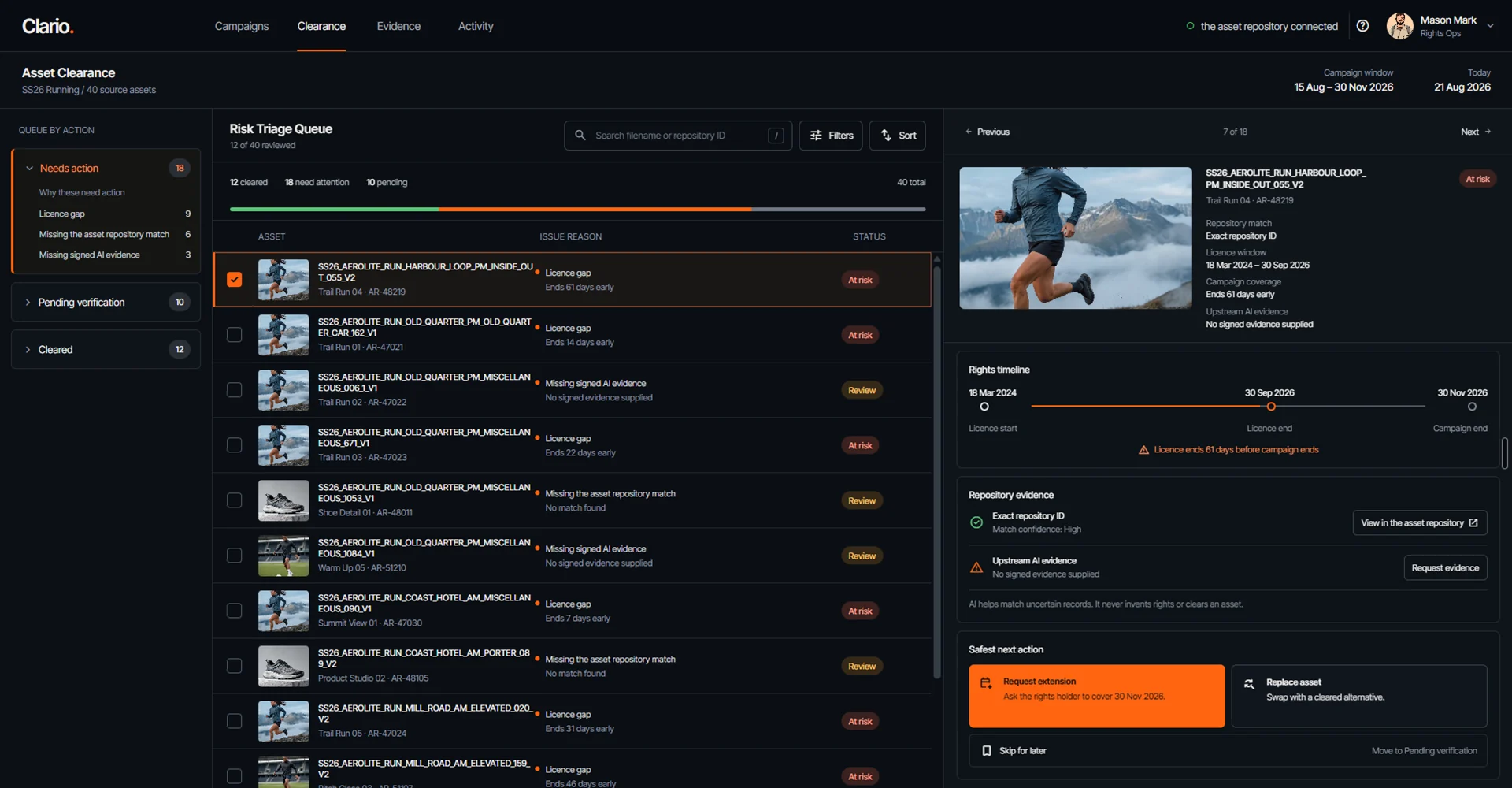
Clario · Rights before automation
A release gate for campaign imagery.
I designed a clearance layer between the asset repository and Celtra so campaign teams can review an entire image batch, understand uncertainty and resolve only the exceptions before production begins.
Context
Observed global sportswear workflow, translated into a public concept
My role
Problem framing, journey design, interaction design and prototyping
Scale
15–40 campaign assets per batch
Status
Concept with simulated records; not shipped or measured
Selection happens one level above the licence.
Campaign imagery arrives as a container, and a producer opens it to a wall of thumbnails. The licence window is not on the thumbnail. It is inside each asset. So the choosing happens at container level while the rights sit one click below, and a container runs from five images to over a thousand.
What fills the gap is trust. The container came from the client, so the working assumption is that it was cleared before it was sent. That assumption is usually right, which is exactly why it survives.
Three things catch it today. None is a control, and all three sit after the money is spent.
- Mid-productionSomeone remembers the dates. It depends on one person still being on the account.
- At publishingThe media team finds it, after every adaptation and market variant is already built.
- After publicationIt goes live and has to be pulled. Rare, which is why the trust holds.
A gate early enough to be cheap.
Clario reads a batch against the campaign’s own dates, markets and channels, and returns one of three verdicts per asset. It reports the margin in days rather than a yes or a no: there is no universally safe buffer, and the producer is the one who knows whether fifteen days of headroom is comfortable or alarming.
The producer operates it, because they are the only role that can act on a conflict. The designer never does, their side of this product is a single line on a brief saying the imagery is verified.
- ClearedCovered by the available evidence, with the remaining margin shown.
- Limited lifeTechnically covered, but thin margin or unresolved information.
- ConflictThe intended activation is not currently covered. Resolve or replace.
Move the whole batch forward. Stop only where evidence breaks.
-
Producer
Connect the repository
Sign in once, read-only access to rights metadata.
-
Producer
Add the batch
Import 15–40 production files without renaming them.
-
Clario
Match records
Embedded ID and manifest first. Visual similarity only as a fallback.
-
Clario
Check coverage
Every licence end date against the planned campaign end.
-
Producer / Client
Resolve exceptions
Confirm a match, request an extension or replace the image.
-
Producer
Release to Celtra
Only cleared assets continue. The designer receives a verified brief.
Most of the design work was deciding what this must never do.
Built this way
- Campaign end, not today
- A green status today is meaningless if the licence expires before the work comes down.
- ID before pixels
- Metadata and manifests are authoritative. Visual similarity is a fallback, and never silent.
- Exceptions before galleries
- The queue groups by next action, not by thumbnail.
- Two paths, no recommendation
- Extend or replace depends on budget and campaign performance, neither of which this tool can see.
- Read-only by design
- Clario records a decision. It never rewrites repository rights.
Refused
- Automatic replacement suggestions
- Rights eligibility is not creative suitability. It cannot see intent, talent or composition.
- Cached eligibility when the source is down
- Stale rights shown as current manufacture confidence, the exact failure this exists to prevent.
- Hard-blocking the stakeholder
- The client owns the commercial decision and may knowingly proceed while resolving in parallel.
- Becoming a rights database
- The repository stays the source of truth. Two disagreeing systems are worse than one imperfect one.
- Grouping related crops
- Variants may be bound for different channels. Related does not mean interchangeable.
AI helps find evidence. It does not become the evidence.
Brand policy prevents generative alteration in day-to-day design work, and Clario respects that boundary: it never creates, retouches or extends campaign imagery. Its one narrow AI role is connecting an imperfect downloaded file to a likely repository record.
Deterministic
Trusted for facts
- Compare campaign and licence dates
- Read embedded IDs and manifests
- Surface missing signed evidence
AI assistance
Used for ambiguity
- Suggest a match for renamed files
- Group likely duplicates
- Summarise long restrictions
Human authority
Required for release
- Confirm a suggested match
- Request an extension or replacement
- Approve assets for Celtra
Missing evidence stays “unknown.” Clario never translates absence into safety.
Connect a repository, import a batch, resolve the exceptions, release. It runs here.
This is a concept with simulated records, so there is no result to report, only the shape of the bet. Expected to reduce image swaps requested after the brief has landed, and to move rights issues from during production to before it.
What would tell me I was wrong: conflicts being resolved upstream but production rework staying flat. That would mean the expiry window was never the real driver, and the problem sits somewhere I have not looked yet.
Product design, concept and prototype
Tathagata Sarkar
Self-initiated
Hero background
Dileepa Nipun
Supplied image
Prototype status
Simulated data · no production credentials or integrations
Full workflow
adidas × HYROX World CupTS_109 · 2026 →